
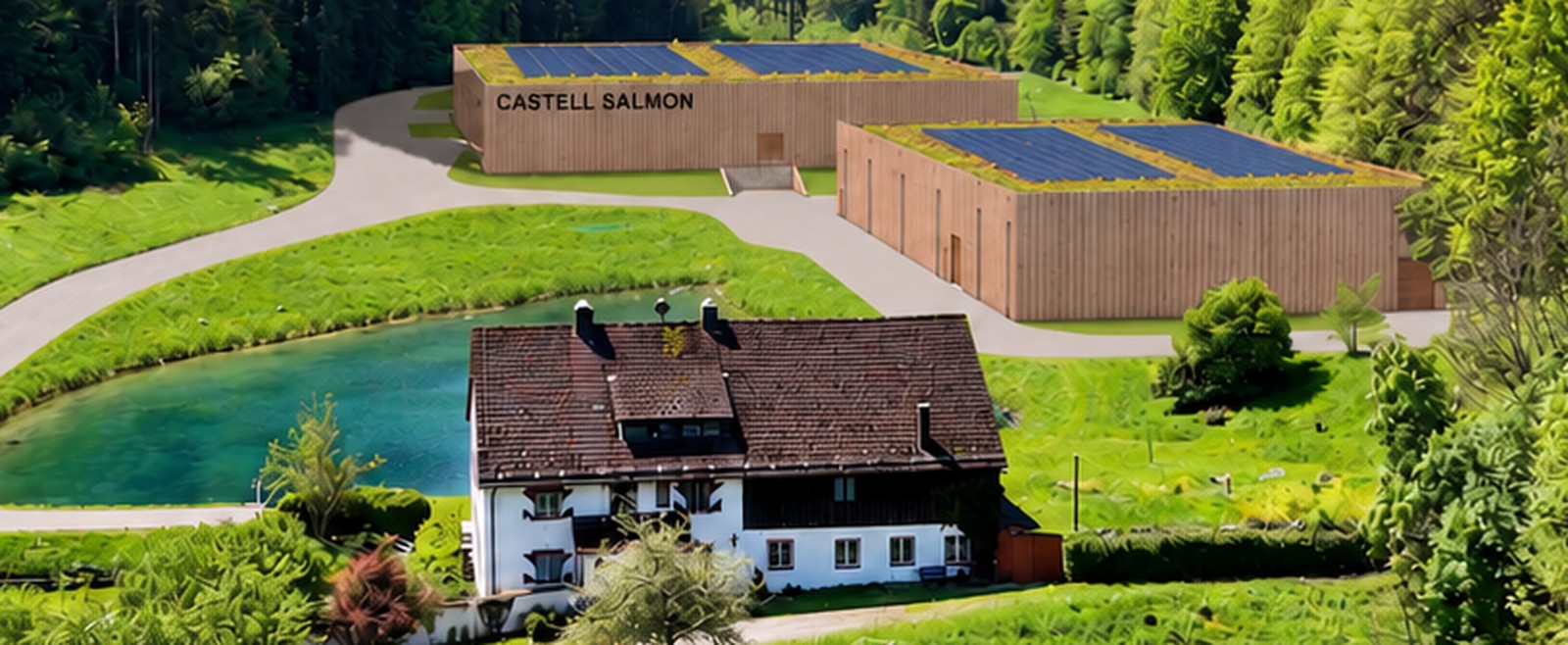
The planned facility at Griestal (visualisation)
The Castell Salmon Farm
The project builds on a historic trout farm, a brownfield aquaculture site, using existing water rights and infrastructure. This approach reduces environmental impact and water use compared to developing untouched land.
A First for Germany
Founders Anton Graf von Faber-Castell and Casimir Graf von Wedel have worked closely with local councils, government agencies, fisheries, and stakeholders for several years to make this project possible.
Castell Salmon is the first salmon project in Germany to secure legally binding permits for construction, water use and environmental impact for a large-scale, land-based salmon farm. This achievement marks the start of a new chapter for sustainable aquaculture in the country.
We dedicate ourselves to delivering premium salmon from egg to plate. Our advanced farming methods ensure we provide fresh, traceable, locally sourced salmon free from antibiotics and raised without exposure to ocean microplastics, meeting the highest standards.
Project Milestones
The Project
This brownfield project redevelops a long-established flow-through trout farm together with its on-site smokehouse and processing facility in Griestal, Markt Rettenbach, in the Allgäu region of Bavaria, 750 metres above sea level. Both have been in operation for decades, allowing us to improve an existing footprint instead of creating new environmental pressures. No new land or water sources are required. We are reusing pre-existing water rights and infrastructure while significantly reducing water use and environmental impact.
Designed to blend into the surrounding landscape, the new facility will raise salmon in pristine alpine water from our own springs. From the first egg to the packaged product, every stage will take place on site, ensuring complete traceability and consistent quality.

Farming Process
Incubation, hatchery, grow-out, humane harvest, specialty smoking, and distribution.

- Delivery of eggs
- Incubation: 8 weeks
- First feeding: 9 weeks
Hatchery

- Smolt Phase 1: 10 weeks
- Smolt Phase 2: 8 weeks
- Smolt Phase 3: 8 weeks
- Post-Smolt: 10 weeks
Nursery

- RAS2020: 44 weeks
- Purge: 1 week
- Harvest
RAS2020 / Grow-Out

- Percussion Stunning
- Filleting
- Smoking
- Quality Control
Processing

- Packaging
- Storage
- Shipping
Distribution
The system will receive five to six batches of eggs per year, and the fish will reach a full harvest size of 4 kg within 22 to 24 months.
A look inside
Sustainable Future
Technology and Sustainability
The farm will use the RAS2020, a modular recirculating aquaculture system now in its third generation, refined over nearly a decade of operation at plants in Switzerland, Denmark and Norway. This system will recycle water, protect surrounding ecosystems and maintain optimal conditions for fish year-round. Our unique design also allows precise control over stocking density, placing fish welfare at the centre of operations to ensure healthy, well-raised salmon. The system eliminates the risk of escape into the wild, avoids exposure to marine microplastic pollution and operates without antibiotics. Delivered to customers in Germany and run on renewable electricity, it produces around 40% fewer carbon emissions than Norwegian sea-cage salmon. This is based on an independent life cycle assessment of the production system and SINTEF's 2022 benchmark for Norwegian salmon.

Water and Environmental Performance
The new facility will operate within the discharge limits set in its permit, which were fixed to protect the stream. Within those limits, the recirculating system produces more fish from less water than the flow-through farm it replaces.
What this Means
AN EXISTING SITE, A SMALLER FOOTPRINT
The historic flow-through farm discharged its water untreated. The new farm treats its process water and returns it within permitted limits.
SAME STREAM, LESS PRESSURE
Treated discharge within permitted loads, against untreated flow-through discharge before.
LESS WATER FROM THE SPRINGS
The recirculating system draws less from the springs than the flow-through farm it replaces, and what it does not need stays in the stream.
MORE FISH FROM THE SAME WATER
The water is cleaned and reused inside the farm, so each litre drawn from the springs raises far more fish than in a flow-through farm.
TREATED WATER, PERMITTED LOAD
Process water passes through the farm's own treatment plant, and the load returned to the stream stays within the limits set by the permit.
MODERNISING AN EXISTING SITE WITH ADVANCED CONTROL
Modernising a historic fish farm. Building on water rights held since 1941. No new intake channel. Mechanical filtration, bio-treatment, and final purification return clean water to the river, with continuous outlet monitoring.
Why it matters
The farm uses less water and returns treated water to the stream, on the same footprint, with a smaller environmental impact than the site's historic operations.
More questions on water and the permit are answered in our FAQ.
Our Commitment
We are committed to producing exceptional salmon without compromise. Our approach combines responsibly sourced German feed, reduced carbon emissions, and ongoing collaboration with leading research and technology partners to improve our methods.
Salmon will be priced in the same category as organic salmon on the market, a premium, local fish at a fair premium.

Building for the Future
Construction is planned to begin once our final detailed design is complete and the local council has completed the drinking water spring it is currently building at Griestal. That spring is one we assigned to the council, securing drinking water for the village. Once operational, the Castell Salmon Farm aims to be among the leading examples of quality, sustainability, and animal welfare in European aquaculture.
Our construction partner, Dobler, is a 150-year-old family business based in the region. We will involve them and local subcontractors throughout the build.

The technology behind the farm
Land-based salmon farming depends on the systems that clean, cool and recirculate the water. See how ours is designed.
EXPLORE THE TECHNOLOGY